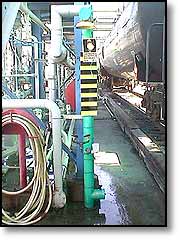
Safety is our number one concern. Prior to inspecting a tank car or carrying out loading/unloading operations a few safety items will be covered. These will ensure that the tank car is properly secured, grounded, and safe to work around.

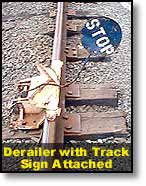
The warning sign(s) must remain in place until you complete your inspection, and if applicable until all loading/unloading lines are disconnected and the tank car is ready to move.
A good practice is to remove the 'blue flag" sign just prior to switching operations.
 |
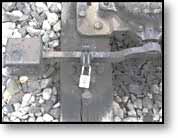 |
The derailers and/or switches must remain locked out until all loading/unloading lines are disconnected and the tank car is safe to move. A good practice is to remove the derailers and unlock the switch(es) just prior to switching operations. The key(s) should be maintained as per your Lock, Tag & Try Program.
All affected personnel should be notified prior to switching operations. No one should be working on or remain in close proximity to the tank car during a switching operation. The exception to this guideline will be the work performed by the tank car switching crews.
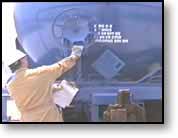
Verify that the handbrake is working by making sure each brake shoe is making contact with its adjacent wheel set. Note: Handbrakes on tank cars with stub sill under frames only apply the brakes on the "B" end truck. Also, handbrake systems that apply braking force to both trucks, depending on the current state of adjustment, may not have every brake shoe in contact with its adjacent wheel set. Consider the latter system effective if at least 80% of the brake shoes are in direct contact the tank cars wheels.
The handbrake should be left set after inspecting, loading, or unloading the tank car to prevent it from drifting. The handbrake should be released just prior to moving the tank car.
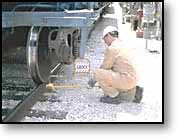
All tank cars are equipped with roller bearing trucks. Roller bearings make it much easier for the tank car to roll free if wheel chocks are not used. Wheel chocks should remain in-place until the tank car is switched. This will reduce the possibility of the tank car drifting should the handbrake prove to be defective.
.jpg)
Attach Grounding Wire (if required). All tank cars carrying flammable materials must be grounded before the tank car is attached to process piping and/or transferring any product.
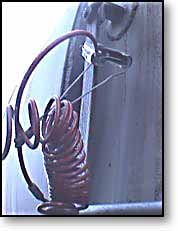
Grounding of a tank car may be accomplished using a grounding clamp (as shown above left) attached to a metallic tank car component or to a grounding lug (as shown below left). The metallic component or grounding lug selected must be paint free in the area the clamp is to be attached, and maintain good electrical continuity to the tank itself.
The grounding wire should be inspected for frayed wires and the clamp checked for good securement. Braided wire should not be used if more than 25% its wires are frayed and the use of "C" type clamps are recommended. A good practice is to have your grounding system checked annually.
Note: The tank car is not grounded just by sitting on the rails due to the lubrication used between the body center plate and the center bowl on the trucks. This lubricant can act as an insulator, thus preventing the tank car from being properly grounded.