Tank Condition

Tank cars must be inspected for leakage before loading. Leaking tank cars can not be loaded or shipped as per AAR Rules.

Look in general for any damage that could make the tank leak, such as abruptly bent, cut, or gouged areas of the tank sheet. If there is an indication of product leakage from under the jacket or from the shell of the tank, care should be taken to ascertain where the product is coming from. The situation should be reported immediately to your supervisor for guidance.
Un-insulated. On an un-insulated tank car with this type of damage, the tank car should not be loaded or pressure unloaded until your supervisor is consulted since there may be fracture cracking in the tank.

Insulated. On insulated tank cars look for sharp or deep cuts that may have penetrated into the tank. Always consult your supervisor before loading or unloading a tank car that has this type of damage.
Care needs to be taken with both insulated and un-insulated tank cars that have damage that could result in a leak. If damage that could result in leakage is found, additional thorough inspection and/or information may be needed before the tank car can be loaded or unloaded. Contact your immediate supervisor and if necessary, your Corporate Logistics, Sales Department, or the tank car leasing company for additional information and guidance.

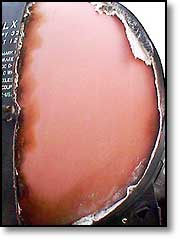
The pictures below show tank car damage which could result in leakage:
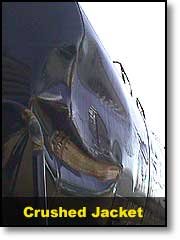
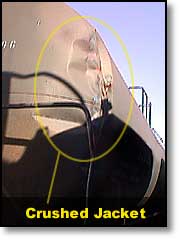
The crushed tank on this un-insulated tank car was caused by a wheel in a derailment. The gouge is so sharp that the tank car should not be loaded or pressure unloaded.
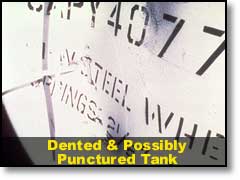
This un-insulated tank car has damage that was possibly caused by a catapulting coupler or end sill in a derailment.
The tank car below was in a derailment. Although it sustained major damage to the end sill, body bolster and end jacket, there was no damage to the tank. This is not always the case.
You must develop a safe action plan in the event of tank damage and/or leaking product. Utilize whatever resource you need to complete the task in a timely and cost effective manner. The first step is to ask some questions:

  • How are you going to off-load this tank car safely?

  • The tank car needs to be off-loaded before it can be repaired. Can you pump it off?

  • Can you use pressure off-loading? You would not be able to answer this question until you do additional investigating.

  • If the product contained in the tank car is a high freezer, can you melt it? You would need to proceed carefully because if there is a crack in the head, then the hot material could run through. Would you be prepared if the heated material started to leak out. If not, preparing for such a situation before heating the material would be in order.

  • Always seek help in making these decisions. You have already had one problem with this tank car. You don’t need a second problem to develop while correcting the first problem.
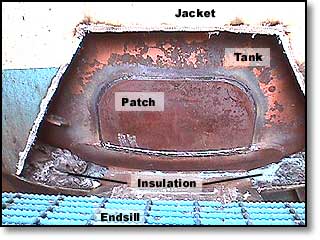
This tank car was also involved in a derailment which resulted in damage caused by a coupler. The hole in the tank caused by the coupler is being prepared for repair after addressing some issues of off-loading the tank car.
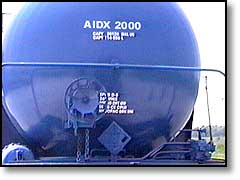
A very good technique is to step back from a tank car and take an overall view. This view gives you the general perspective of the tank car, not only taking in the tank condition, but also paint and stenciling. It is often when you take this overall look that something will "just not look right".